

Windows and Doors Market to Reach $363.23 Billion by 2035 as Energy Codes and Urbanization Reshape Building Envelopes
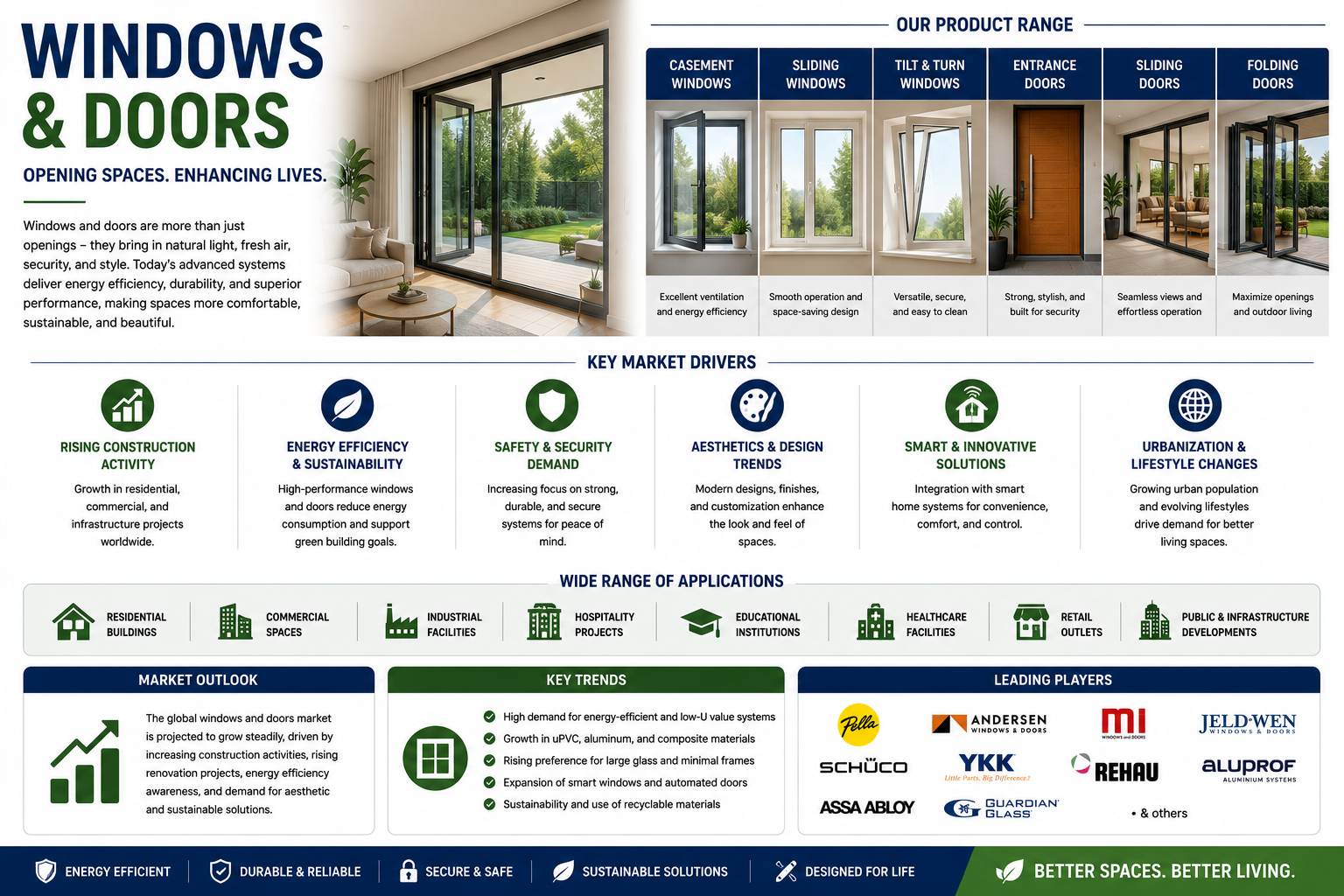
Windows and Doors
Asia-Pacific contributed the largest regional revenue share at 44.6%, while the Middle East & Africa is anticipated to grow at a 7.55%
EUROPE, UNITED KINGDOM, July 7, 2026 /EINPresswire.com/ -- The humble window and door—once a simple aperture in a wall—has become one of the most strategically important components of modern construction. As buildings account for roughly 40% of global energy consumption, policymakers, architects, and developers are increasingly recognizing that high-performance fenestration is not a finishing detail but a fundamental determinant of energy efficiency, occupant comfort, and regulatory compliance. According to a comprehensive report by Market Research Future (MRFR), the global windows and doors market was valued at USD 229.90 billion in 2025 and is projected to grow from USD 240.66 billion in 2026 to USD 363.23 billion by 2035, registering a CAGR of 4.68%. This expansion is being driven by tightening building-envelope performance codes, sustained renovation spending in mature economies, and massive urbanization waves across developing regions.The Regulatory Revolution: Energy Codes as Market Architects
No force is reshaping the windows and doors market more decisively than the global tightening of energy-efficiency regulations. In the United States, the ENERGY STAR Version 7.0 standard—finalized by the EPA in 2024—tightens maximum U-factor requirements to 0.22 Btu/h·ft²·°F for northern climate zones, a 21% reduction from Version 6.0. This single regulatory update is expected to shift roughly 35% of U.S. residential window shipments toward triple-pane configurations by 2028. Canada's parallel National Energy Code for Buildings (NECB 2025) reinforces this cross-border demand pull, pushing builders toward triple-glazed configurations in provinces above the 49th parallel.
In Europe, the revised Energy Performance of Buildings Directive (EPBD) targets zero-emission new construction by 2030, compelling developers to specify higher-performance fenestration from the design stage. The European Commission's Renovation Wave Strategy aims to double the annual energy-renovation rate to 2% of the building stock, translating into approximately 35 million building-unit renovations by 2030. Window and door replacement represents the single largest line item in typical deep-energy retrofits, often accounting for 30–40% of envelope upgrade budgets. National incentive programs—Germany's BEG subsidy (which allocated EUR 16.7 billion in 2024 alone), France's MaPrimeRénov', and Italy's Superbonus—are channeling billions toward high-performance fenestration replacements.
Get Report Sample Copy with TOC: https://www.marketresearchfuture.com/sample_request/11996
Technology Shift: From Commodity to Smart Building System
A technology revolution is reshaping the windows and doors market from the supply side. Traditional single-pane and basic double-pane units are giving way to vacuum-insulated glazing, electrochromic smart glass, and composite framing systems that cut thermal bridging by up to 60%. Electrochromic and thermochromic glazing technologies have moved from pilot to serial production, with global installed capacity surpassing 8 million square meters in 2024. View Inc. and SageGlass (Saint-Gobain) report commercial-building payback periods dropping below seven years when dynamic glazing replaces static glass plus motorized blinds. Integration with building-management systems enables real-time tint adjustment, cutting HVAC loads by up to 20%.
Automated fabrication lines—some capable of producing 1,200 insulated glass units per shift—are compressing lead times and enabling mass customization, a trend particularly visible in European and East Asian manufacturing hubs. Artificial intelligence is entering the market through two channels: generative design tools that optimize frame profiles for thermal performance and structural load, and machine-vision quality-control systems on fabrication lines that reduce defect rates below 0.3%. By 2030, digitally enabled manufacturing could lower fenestration production costs by 12–18%, making high-performance products accessible to mid-market segments.
Product and Material Dynamics
Doors currently hold the dominant revenue position, capturing an estimated 62.0% share of the windows and doors market in 2025, reflecting the sheer volume of residential entry, interior, and patio-door installations globally. The segment benefits from shorter replacement cycles and lower price sensitivity compared to windows. Windows, however, are the faster-growing segment with a projected CAGR of 7.90%, driven by energy-code-driven upgrade cycles and the shift toward triple-pane and vacuum-glazing adoption in colder climate zones.
By material, metal framing (aluminum and steel) accounted for roughly 49.3% of the market in 2025, reflecting commercial-project specification dominance where aluminum's strength-to-weight ratio enables large-span curtain-wall and storefront configurations. Plastic, uPVC, and composite materials represent the fastest-growing segment at a CAGR of 9.25%, driven by superior thermal insulation properties, low maintenance requirements, and competitive pricing that resonates with residential retrofit budgets. Wood retains a premium niche valued at approximately USD 38.72 billion, particularly in Scandinavian and North American markets where aesthetic preferences and heritage building codes sustain demand.
By application, swinging doors and casement windows remain the default specification, holding 42.5% of the market. Folding mechanisms—bi-fold doors and accordion-style window walls—are the fastest-growing application type at a CAGR of 10.15%, gaining rapid traction in luxury residential, hospitality, and restaurant design where seamless indoor-outdoor transitions command premium pricing.
End-User Landscape: Residential Dominance, Non-Residential Acceleration
Residential end users represented approximately 62.5% of global demand in 2025, reflecting the enormous scale of single-family and multi-family housing construction worldwide. The U.S. combination of an aging housing stock—median home age exceeding 40 years—and federal tax incentives under the Inflation Reduction Act (up to USD 600 per qualifying window replacement) sustains robust retrofit demand. India's Pradhan Mantri Awas Yojana – Urban scheme alone targets completion of 12 million housing units by 2028, each requiring an average of six to eight window and door units.
Non-residential end users—spanning commercial offices, industrial facilities, and institutional buildings—represent the faster-growing segment at a CAGR of 8.70%. Green-building certification requirements (LEED, BREEAM, WELL) increasingly mandate high-performance fenestration in new commercial construction. The EU's EPBD will require the worst-performing 15% of non-residential buildings to meet minimum energy-performance standards starting in 2030, effectively mandating fenestration replacement in millions of structures.
Regional Dynamics: Asia-Pacific Leads, Middle East & Africa Surges
Asia-Pacific commands roughly 44.6% of the windows and doors market, the largest regional share, underpinned by large-scale residential construction in China and India. China's dominance reflects both its enormous construction volume and the government's push to raise building energy-efficiency ratings under the 14th Five-Year Plan. India is the fastest-growing country-level market in the region, propelled by PMAY's urban housing targets and the rapid expansion of organized retail and commercial real estate in tier-2 and tier-3 cities, posting a CAGR of 8.45%.
Europe holds the second-largest share at approximately 24.5%, where deep-energy retrofit mandates continue to fuel replacement demand. Germany leads the region with 26.8% of regional revenue, driven by its BEG subsidy program. The UK's Future Homes Standard, effective from 2025, mandates a 75% reduction in carbon emissions from new dwellings compared to current norms, pushing specification toward triple-glazed, thermally broken window systems.
North America accounts for 18.2% of the market, with the United States dominating at 78.5% of regional revenue. The ENERGY STAR 7.0 compliance cycle and single-family renovation activity sustain growth. Mexico contributes approximately USD 4.92 billion, driven by social housing expansion through INFONAVIT financing.
The Middle East & Africa is the fastest-growing region at a projected CAGR of 7.55%, driven by mega-project pipelines such as Saudi Arabia's NEOM and The Line, Egypt's New Administrative Capital (designed for 6.5 million residents), and the UAE's post-Expo hospitality and mixed-use build-out. Saudi Arabia alone accounts for 34.8% of regional revenue, with Vision 2030 projects collectively requiring millions of fenestration units through the early 2030s.
South America holds 6.8% of global share, with Brazil dominating at 61.4% of regional revenue through its Minha Casa Minha Vida housing program, revived in 2023 with a target of 2 million units by 2026.
Buy Now: https://www.marketresearchfuture.com/checkout?currency=one_user-USD&report_id=11996
Headwinds: Raw Materials, Labor, and Cost Barriers
The market is not without challenges. Volatile raw-material prices—aluminum fluctuated between USD 2,100 and USD 2,650 per metric ton during 2023–2024, while PVC resin prices increased 18%—are squeezing manufacturer margins and stalling order commitments. Skilled-labor shortages in installation trades represent a structural constraint: the U.S. Bureau of Labor Statistics projects the construction industry will need 501,000 more workers annually until 2032, with glazing and fenestration installation among the hardest trades to fill. Germany is short 62,000 workers in building-envelope crafts. These limitations reduce installation throughput and increase project timelines, slowing the rate at which specification victories convert to recognized revenue.
The high upfront cost of premium systems also acts as a barrier in emerging markets, where cost-effective uPVC and aluminum products dominate over high-performance triple-glazed or smart-glass configurations. Complex permitting and compliance requirements across fragmented regulatory environments add further friction.
Circular Economy and the Future of Fenestration
Sustainability is evolving from a marketing differentiator to a regulatory mandate. The EU's proposed Construction Products Regulation revision mandates minimum recycled-content thresholds for construction materials by 2030. Aluminum profiles already achieve 75% recycled-input rates in closed-loop systems, and VEKA and Rehau have demonstrated commercially viable 100% recycled-PVC profile extrusion. Extended producer responsibility (EPR) frameworks are gaining legislative traction in the EU, UK, and Japan, requiring manufacturers to bear end-of-life collection and recycling obligations. Companies that invest early in take-back logistics and recycled-content certification will secure preferential specification status.
Building Information Modeling (BIM) adoption is expected to exceed 80% penetration in commercial construction by 2028. Fenestration suppliers embedding digital-twin data—including thermal simulations, acoustic models, and lifecycle-cost projections—into BIM object libraries will capture specification influence earlier in the project lifecycle. This shift transforms competitive dynamics from price-based bidding toward performance-data leadership.
The windows and doors market's trajectory from USD 229.90 billion to USD 363.23 billion reflects a fundamental reclassification of fenestration from a commodity building component to a performance-critical building system. Regulatory mandates for energy efficiency and net-zero construction, combined with massive urbanization in Asia-Pacific and the Middle East, are creating a decade-long demand pipeline that is largely insensitive to macroeconomic cycles. Manufacturers that invest in smart-glass integration, automated fabrication, recycled-material supply chains, and digital specification platforms are positioned to capture disproportionate growth. For architects, developers, and policymakers, the message is clear: the window is no longer just an opening in the wall. It is a strategic lever for decarbonization, occupant well-being, and regulatory compliance in the buildings of tomorrow.
Related Report
Copper Alloy Foils Market https://www.marketresearchfuture.com/reports/copper-alloy-foils-market-3832
Residential Real Estate Market https://www.marketresearchfuture.com/reports/residential-real-estate-market-11577
Syngas Market https://www.marketresearchfuture.com/reports/syngas-market-7487
Melamine Formaldehyde Market https://www.marketresearchfuture.com/reports/melamine-formaldehyde-market-4745
Crumb Rubber Market https://www.marketresearchfuture.com/reports/crumb-rubber-market-25500
Market Research Future
Market Research Future
+1 855-661-4441
email us here
Legal Disclaimer:
EIN Presswire provides this news content "as is" without warranty of any kind. We do not accept any responsibility or liability for the accuracy, content, images, videos, licenses, completeness, legality, or reliability of the information contained in this article. If you have any complaints or copyright issues related to this article, kindly contact the author above.
